When Should Connecticut Families Start College Planning?
A practical timeline for freshmen, sophomores, and juniors covering grades, SAT and ACT prep,
college visits, financial aid, applications, and how to reduce stress before senior year.
Most families wait too long to start college planning.
Not because they do not care. Not because they are unorganized. Usually, it happens because college feels far away until suddenly it does not.
Freshman year turns into sophomore year. Sophomore year turns into junior year. Then families find themselves trying to handle
SAT or ACT prep, college visits, applications, essays,
financial aid strategy, scholarship questions, and college costs all at the same time.
That is when the stress hits.
The better approach is to start earlier, but not with panic. Early college planning does not mean your child needs to know their major in ninth grade or have a final college list by sophomore year. It means your family has a thoughtful plan that gives your student more options, more time, and less pressure.
For Connecticut families, especially families in Hartford County, West Hartford, Rocky Hill, Glastonbury, Farmington, Avon, Simsbury, and surrounding towns, the college planning process should start earlier than most parents think.
Here is a practical college planning timeline for freshmen, sophomores, and juniors.
Why Early College Planning Matters
College planning is not just about getting accepted.
It is about finding the right academic, social, and financial fit.
- What type of school is actually right for my child?
- Which colleges are realistic academically and financially?
- Should my student take the SAT, ACT, both, or neither?
- When should we visit colleges?
- How do we avoid overpaying?
- Will we qualify for financial aid?
- How do merit scholarships work?
- What should we be doing now so senior year is not overwhelming?
When families wait until senior year, many of those questions become urgent. When families start earlier, they can make better decisions with less emotion and more strategy.
That is the real value of early college planning.
More time to build the right college list
Less pressure around testing and applications
Smarter financial and merit-aid decisions
Helpful public tools like the
FAFSA application from Federal Student Aid,
the CSS Profile from College Board,
and the U.S. Department of Education’s College Scorecard
can help families understand parts of the process. But the real challenge is knowing how all the pieces work together for your specific student and financial situation.
Freshman Year: Build the Foundation
Freshman year is not about creating a final college list. It is about helping your student build habits, confidence, and direction.
At this stage, parents should focus on the basics.
Your student’s grades matter. Colleges look at the full high school transcript, not just junior and senior year. A strong freshman year can set the tone, while a weak freshman year may require extra work later.
Freshman year is also a good time to help your child explore interests. That could mean clubs, sports, volunteering, part-time work, creative projects, leadership opportunities, or academic areas they may want to pursue more seriously.
The goal is not to manufacture a resume. The goal is to help your student discover what they enjoy and where they naturally invest effort.
Freshman Year College Planning Checklist
- Build consistent study habits and time management skills.
- Choose appropriate classes that challenge the student without overwhelming them.
- Get involved in meaningful activities, not just activities that “look good.”
- Begin learning how college costs, financial aid, and scholarships work.
- Have light, low-pressure conversations about college and future goals.
Parents should begin learning how college costs work, especially if they have not gone through the process before. Many families are surprised to learn that the sticker price is not always the final price, and that two schools with similar published costs can produce very different financial outcomes.
For a deeper freshman-year breakdown, read our guide to
freshman year college prep for Connecticut parents.
Sophomore Year: Start Creating Direction
Sophomore year is when college planning should become more intentional.
This is the year to begin identifying academic strengths, possible areas of interest, and the type of college environment that may fit your student best.
Some students will already have clear interests. Others will have no idea what they want to study. Both are normal.
What matters is that the family starts paying attention.
- Is your child stronger in math and science, or reading and writing?
- Do they prefer small classes or bigger environments?
- Do they like structured settings or more independence?
- Are they motivated by competition, creativity, service, business, technology, health care, or something else?
Sophomore year is also a smart time to begin understanding standardized testing.
Students do not necessarily need intensive SAT or ACT prep yet, but they should begin learning the differences between the tests and when they may take them. For many families, waiting until junior year to even think about testing creates unnecessary stress. Families can start with official resources from the
College Board SAT
and the ACT, then build a strategy around the student’s strengths.
Sophomore Year College Planning Checklist
- Continue building strong grades in appropriate classes.
- Explore possible majors, career interests, and school types.
- Consider a practice SAT or ACT to establish a baseline.
- Begin learning about FAFSA, CSS Profile, merit aid, and true college cost.
- Visit different types of campuses casually, not only top-choice schools.
Parents should start learning about the financial side of college in more detail. This includes need-based aid, merit scholarships,
FAFSA and CSS Profile planning, in-state versus out-of-state costs, and how different colleges award money.
This is also a good time to begin visiting a few different types of colleges casually. Not necessarily top-choice schools yet. Instead, visit different categories: large public university, smaller private college, urban campus, suburban campus, and maybe a school close to home.
The goal is to help your student learn what they like and dislike before building the real college list.
Junior Year: The Most Important Planning Year
Junior year is when college planning becomes real.
Grades, testing, college visits, extracurricular leadership, teacher relationships, and college list development all matter during this year.
This is also the year when many families feel the pressure increase. That is why planning before junior year can be so valuable.
A rising junior who uses summer wisely can enter the school year with a major advantage. They may begin SAT or ACT prep, visit a variety of colleges, narrow down preferences, and understand what the year ahead will require.
One common mistake families make is spending the summer before junior year only visiting top-choice colleges.
Summer visits can be useful, but many campuses are quiet or empty. Students may be away, classes may not be in session, and the energy of the school may feel very different from the academic year.
That does not mean summer college visits are bad. It means they should be part of a bigger strategy.
For many rising juniors, summer is also one of the best times to focus on SAT or ACT prep. Even one focused hour a day can reduce stress dramatically by the holidays, when schoolwork, activities, testing, college visits, and applications begin piling up.
Junior Year College Planning Checklist
- Finalize a testing plan for the SAT, ACT, both, or test-optional strategy.
- Continue building strong grades and academic momentum.
- Deepen involvement in meaningful activities and leadership roles.
- Visit colleges strategically, including during active campus periods when possible.
- Build a balanced college list with academic, social, and financial fit in mind.
- Start comparing net price, merit aid, and potential return on investment.
Parents should start comparing college costs, understanding financial aid eligibility, reviewing merit scholarship opportunities, and making sure the family is not building a college list based only on reputation or emotion.
By the end of junior year, families should ideally have a strong working college list, a clear testing plan, an understanding of affordability, and a sense of what applications will require.
For families in central Connecticut, our guide to
college planning in Hartford County
explains how local families can connect admissions strategy, cost strategy, and school fit.
Senior Year: Execute the Plan
Senior year should not be the year when families start figuring everything out.
It should be the year when they execute the plan they have already built.
That includes finalizing the college list, completing applications, writing essays, submitting financial aid forms, comparing offers, and making the final decision.
When students begin senior year without a plan, the process can feel chaotic. When they enter senior year prepared, the experience is still busy, but much more manageable.
This is where earlier planning pays off.
A strong college planning timeline can help families avoid rushed decisions, missed deadlines, poor-fit schools, unnecessary debt, and last-minute stress.
The families who build the strategy earlier usually have more room to compare colleges, negotiate or appeal aid when appropriate, and make decisions based on fit and price instead of pressure.
What Connecticut Families Should Be Thinking About
Connecticut families face some specific college planning challenges.
Many students look at a mix of Connecticut schools, New England colleges, large public universities, private colleges, and out-of-state options. The cost differences can be significant.
A school with a high sticker price may offer strong merit aid. A public university may be less expensive upfront but not always the best financial fit depending on the student and family situation. Some private colleges may be more generous than parents expect. Others may not be.
This is why college planning should connect admissions strategy with financial strategy.
Choosing colleges without understanding cost is risky. Choosing colleges based only on cost can also be limiting.
The best plan looks at both.
Families can compare public data through tools like
College Navigator from the National Center for Education Statistics
and the
College Scorecard,
but those tools are only the starting point. Your student’s profile, intended major, likely aid eligibility, scholarship opportunities, and family financial picture all need to be considered together.
That is also why we pay close attention to data sources like the
Common Data Set
when reviewing admission and school-fit strategy. You can also read how we use this kind of information in our guide to
impacted majors and the Common Data Set.
When Is the Best Time to Start College Planning?
The best time to start college planning is usually sophomore year.
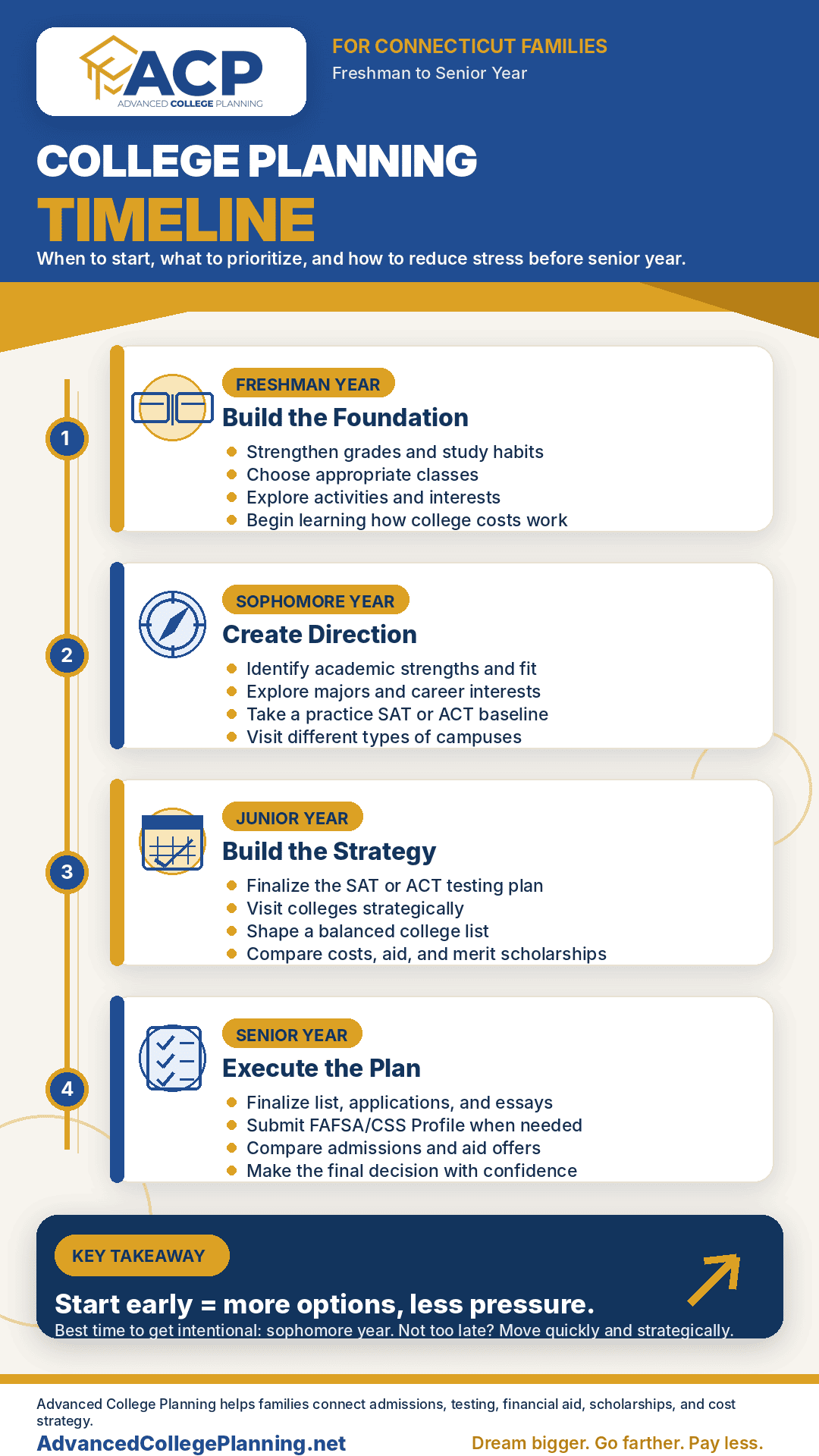
Freshman year is ideal for building a foundation. Sophomore year is ideal for creating direction. Junior year is when the plan becomes more detailed and strategic.
If your child is already a junior, it is not too late. But it is important to move quickly and intentionally.
If your child is a rising junior, summer is a major opportunity. This is the time to think through testing, college visits, academic goals, financial expectations, and the type of college experience your student actually wants.
The families who plan early usually have more options. They also tend to feel less overwhelmed when senior year arrives.
How Advanced College Planning Helps
At Advanced College Planning, we help Connecticut families create a
complete college plan.
That means looking at the student, the school list, the testing strategy, the application timeline, the financial aid process, merit scholarship opportunities, and the family’s bigger financial picture.
We are not just helping students apply to college. We are helping families make smarter college decisions.
Advanced College Planning was also named a BusinessRate Best of 2026 Award Winner in the Educational Consultant category for Rocky Hill, Connecticut, a recognition powered by Google Reviews.
For families, that matters because college planning requires trust. Parents want guidance from people who understand the process, communicate clearly, and help families make decisions with confidence.
Learn more about our
Connecticut college planning team
or schedule a free call to talk through where your family is in the process.
Final Thoughts
College planning does not have to be overwhelming.
But it does need to start early enough to be useful.
Freshman year builds the foundation. Sophomore year creates direction. Junior year brings strategy. Senior year is execution.
If your family wants to reduce stress, avoid rushed decisions, and build a smarter college plan, the best time to start is before the process feels urgent.
Advanced College Planning helps Connecticut families dream bigger, go farther, and pay less.
College Planning FAQ
When should families start college planning?
Families should ideally start college planning during sophomore year of high school. Freshman year is useful for building strong habits and academic foundations, while sophomore year is a good time to begin exploring colleges, testing options, financial aid, and long-term planning.
Is freshman year too early to start college planning?
Freshman year is not too early to start building the foundation for college. Students do not need a final college list yet, but grades, course selection, study habits, and activities all begin to matter.
What should sophomores do for college planning?
Sophomores should focus on strong grades, meaningful activities, early career and major exploration, understanding SAT and ACT options, and beginning to learn what types of colleges may be a good fit.
Why is junior year so important for college planning?
Junior year is important because grades, standardized testing, college visits, teacher relationships, and college list development all become more serious. Families who enter junior year with a plan usually experience less stress.
Should rising juniors do SAT or ACT prep during the summer?
Yes, summer can be one of the best times for rising juniors to begin SAT or ACT prep. With fewer school-year distractions, students can build consistency and reduce pressure later in the year.
Should families visit colleges during the summer?
Summer college visits can be helpful, but families should remember that many campuses are quieter when students are away. Summer visits should be part of a broader college planning strategy, not the only step.
Ready to Build a Smarter College Plan?
Schedule a college planning consultation with Advanced College Planning and learn how we help Connecticut families navigate admissions, testing, financial aid, scholarships, and college costs with a clear strategy.
Educational guidance only. College costs, admissions outcomes, financial aid eligibility, scholarships, and savings vary based on each student, school list, and family financial situation.
About the author
Jeffrey Bliss
Lead College Planner · Advanced College Planning, LLC
Jeff helps Connecticut families find right-fit colleges and win the merit aid that lowers the real cost of attendance. His focus: merit aid strategy, SAT/ACT planning, FAFSA & CSS Profile guidance, and financial aid appeals.