Can Business Owners Qualify for Financial Aid? FAFSA and CSS Profile Rules Explained
Many business owners assume they earn too much, own too much, or have too complicated a tax situation to qualify for college financial aid. That assumption can be expensive.
Direct Answer: Can Business Owners Qualify for Financial Aid?
Yes, business owners can qualify for financial aid. However, business income, business assets, retained earnings, tax structure, and CSS Profile requirements can make the process more complex than it is for W-2 families.
For Connecticut business owners, the real question is not simply whether you qualify. The better question is how each college will evaluate your income, assets, business value, and ability to pay.
At Advanced College Planning, we help business-owner families understand FAFSA, CSS Profile, merit aid, college selection, and cost-reduction strategies before applications are submitted.
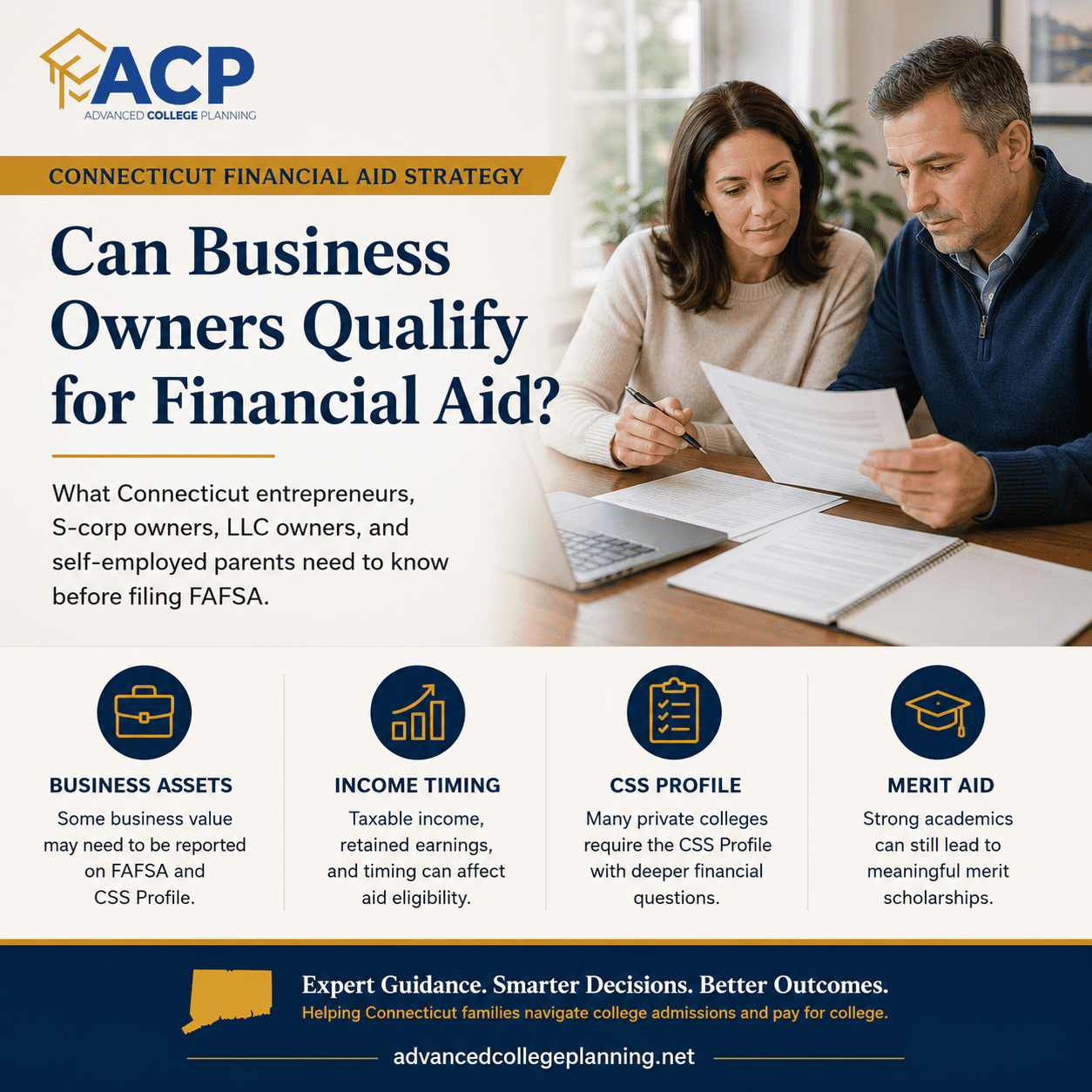
Quick Facts About Financial Aid for Business Owners
- Business owners may still qualify for financial aid.
- FAFSA and CSS Profile may evaluate business finances differently.
- Business income is not always the same as household cash flow.
- Some business assets may need to be reported on FAFSA, depending on current rules.
- Private colleges using CSS Profile may ask more detailed business questions.
- Merit aid may still be available regardless of income.
- College selection can dramatically change the final cost.
Why Business Owners Need a Different College Planning Strategy
Most financial aid advice is written for families with simple W-2 income. Business owners often have a more complicated financial picture.
Your tax return may show income that does not reflect your actual cash flow. Your business may have equipment, inventory, real estate, retained earnings, depreciation, loans, or variable revenue. A college financial aid office may look at these items differently than a tax preparer or banker would.
This is why generic FAFSA advice often falls short for entrepreneurs, S-corp owners, LLC owners, real estate professionals, contractors, medical practice owners, and self-employed parents.
How FAFSA Looks at Business Owners
FAFSA is the federal financial aid form used by colleges to determine eligibility for federal aid and often to support institutional aid decisions.
Business-owner families should pay close attention to asset questions, income questions, and contributor information. Federal Student Aid guidance explains that families may need to report the current net worth of certain businesses and farms depending on the FAFSA year and reporting rules.
Because FAFSA rules can change, business owners should not rely on outdated assumptions. Review the current FAFSA instructions and consider professional guidance before submitting.
Business Income vs. Actual Cash Flow
Business income can be misleading.
A business owner may show strong taxable income but still have significant payroll, inventory costs, debt service, reinvestment needs, or seasonal revenue swings. Another owner may show lower taxable income because of deductions, depreciation, or timing issues.
Colleges may still focus heavily on reported income, even when the business owner feels that income does not reflect what is actually available to pay for college.
This is one reason planning should begin before senior year.
Business Assets and FAFSA
One of the most confusing questions for business owners is whether business assets must be reported.
Reportable business value may include the current net worth of a business, which generally means the value of the business minus business debt. Depending on the FAFSA year and current rules, certain business and farm assets may need to be included.
Business owners should not guess. They should review current FAFSA instructions carefully and avoid either over-reporting or under-reporting assets.
CSS Profile for Business Owners
The CSS Profile is separate from FAFSA. Many private colleges use CSS Profile to award institutional grants and scholarships.
CSS Profile can be more detailed than FAFSA and may ask about business ownership, business value, income, losses, assets, debt, and special circumstances.
This matters because a family may look one way on FAFSA and very different to a CSS Profile college.
For business owners, the college list matters. Two colleges with similar sticker prices may produce very different financial aid outcomes.
Can S-Corp Owners Qualify for Financial Aid?
Yes, S-corp owners can qualify for financial aid, but planning can be complicated.
Financial aid forms may consider wages, distributions, business income, retained earnings, and business value. The family’s tax strategy may not align perfectly with financial aid strategy.
An S-corp owner should not assume that reducing taxable income alone creates the best college planning outcome. The right strategy depends on the student, family finances, college list, and timing.
Can LLC Owners Qualify for Financial Aid?
Yes, LLC owners can qualify for financial aid.
However, LLC income, business expenses, assets, and ownership structure can affect how the family is viewed by colleges. Single-member LLCs, partnerships, and multi-owner businesses may raise different questions.
Families should be prepared to explain income fluctuations, business debt, nonrecurring income, and unusual financial circumstances when appropriate.
Can Self-Employed Parents Qualify for Financial Aid?
Yes. Self-employed parents can qualify for financial aid, but documentation matters.
Colleges may review tax returns, schedules, business income, and other financial information. If income fluctuates year to year, families may need to explain the circumstances clearly.
This is especially important for consultants, real estate professionals, contractors, medical providers, independent sales professionals, and freelancers.
Merit Aid May Matter More Than Need-Based Aid
Many business owners assume that financial aid only means need-based aid.
That is a mistake.
Merit aid can be available to families regardless of income. Colleges may offer scholarships to students based on grades, rigor, test scores, leadership, talent, or institutional priorities.
For many business-owner families, the best college cost strategy combines financial aid planning with merit aid strategy and smart college selection.
Common Mistakes Business Owners Make With College Planning
Mistake #1: Assuming They Will Not Qualify
Many business owners skip financial aid planning because they believe their income is too high or their situation is too complex.
Mistake #2: Choosing Colleges Without Understanding Aid Policies
Different colleges evaluate business-owner families differently. School selection matters.
Mistake #3: Confusing Tax Planning With Financial Aid Planning
A good tax strategy is not automatically a good financial aid strategy. The two should be coordinated carefully.
Mistake #4: Waiting Until Senior Year
By senior year, many decisions are already locked in. Earlier planning creates more options.
Mistake #5: Ignoring CSS Profile
Business owners applying to private colleges must understand whether CSS Profile is required and what additional information may be requested.
Official FAFSA and CSS Profile Resources
Business owners should review current FAFSA guidance directly from Federal Student Aid.
Federal Student Aid also provides information about the current net worth of businesses and farms for FAFSA reporting.
Families applying to private colleges can review the CSS Profile, which is used by many colleges and scholarship programs for institutional aid.
Connecticut Business Owner Family Example
A Connecticut family owned a profitable small business and assumed they would receive no help paying for college.
The family focused only on admissions and did not initially compare how different colleges would evaluate their business income, assets, and student profile.
After reviewing the college list, financial aid forms, and merit scholarship opportunities, the family discovered that some colleges were likely to be much more favorable than others.
The family’s income did not change. The strategy changed.
The Advanced College Planning Business Owner College Cost Framework
When helping business-owner families, Advanced College Planning focuses on five areas.
Advanced College Planning Expert Insight
Business owners should not approach college planning with generic advice.
The strongest outcomes usually come from coordinating financial aid strategy, merit aid strategy, school selection, and timing.
The goal is not simply to complete FAFSA. The goal is to make informed decisions that reduce unnecessary college costs and preserve family financial flexibility.
Frequently Asked Questions About Financial Aid for Business Owners
Can business owners qualify for financial aid?
Yes. Business owners can qualify for financial aid, but income, assets, business structure, and college aid policies can make the process more complex.
Does FAFSA count business income?
FAFSA uses tax and financial information that may include income connected to business ownership.
Do business assets count on FAFSA?
Some business assets may need to be reported depending on current FAFSA rules and the FAFSA year. Families should review current instructions carefully.
Is CSS Profile different for business owners?
CSS Profile may ask more detailed questions about business ownership, business value, income, losses, assets, and debt.
Can S-corp owners receive financial aid?
Yes. S-corp owners may receive financial aid, but wages, distributions, business income, and assets may need to be reviewed carefully.
Can LLC owners receive financial aid?
Yes. LLC owners can qualify for financial aid, but the structure and finances of the business may affect how colleges evaluate the family.
Can self-employed parents qualify for financial aid?
Yes. Self-employed parents may qualify, but documentation and income fluctuations can make planning more important.
Does business debt matter for financial aid?
Business debt may affect the net value of a business, but how it is considered depends on the form and college policy.
Can business owners get merit aid?
Yes. Merit aid is often based on the student’s academic profile and institutional priorities rather than family income alone.
Should business owners file FAFSA?
In many cases, yes. Filing FAFSA may preserve access to federal student loans, institutional aid, scholarships, and future aid opportunities.
When should business owners start college planning?
Ideally before senior year. Earlier planning gives families more time to evaluate income, assets, school selection, and merit aid opportunities.
How can Advanced College Planning help business owners?
Advanced College Planning helps Connecticut business-owner families understand FAFSA, CSS Profile, merit aid, college selection, and cost-reduction strategies.
Related Financial Aid Resources
- What Income Is Too High for FAFSA?
- FAFSA for Divorced Parents
- Schedule a Consultation With Advanced College Planning
- FAFSA vs CSS Profile Explained. Coming Soon
- How to Appeal a Financial Aid Award. Coming Soon
Own a Business and Wondering How College Financial Aid Works?
Business-owner families should not rely on generic FAFSA advice.
Advanced College Planning helps Connecticut entrepreneurs, S-corp owners, LLC owners, and self-employed parents build smarter college funding strategies before costly mistakes happen.