SAT vs. ACT in 2026: Which Test Gives Connecticut Students the Best Chance at Admission and Scholarships?
Most colleges do not prefer one test over the other. The better question is which test helps your student earn the strongest score, strengthen their application, and improve scholarship opportunities.
One of the most common questions we hear from Connecticut families is simple:
Should my child take the SAT or the ACT?
The answer surprises many parents. For most colleges, there is no preference. Admissions offices generally accept both exams equally.
The real question is not which test colleges prefer. The better question is:
Which test gives your student the best chance to earn the highest score, improve admissions outcomes, and potentially qualify for more merit-based scholarships?
At Advanced College Planning, we help Connecticut families build a complete college strategy that includes admissions, SAT and ACT preparation, financial aid, merit scholarships, FAFSA, CSS Profile planning, college selection, essays, and appeals.
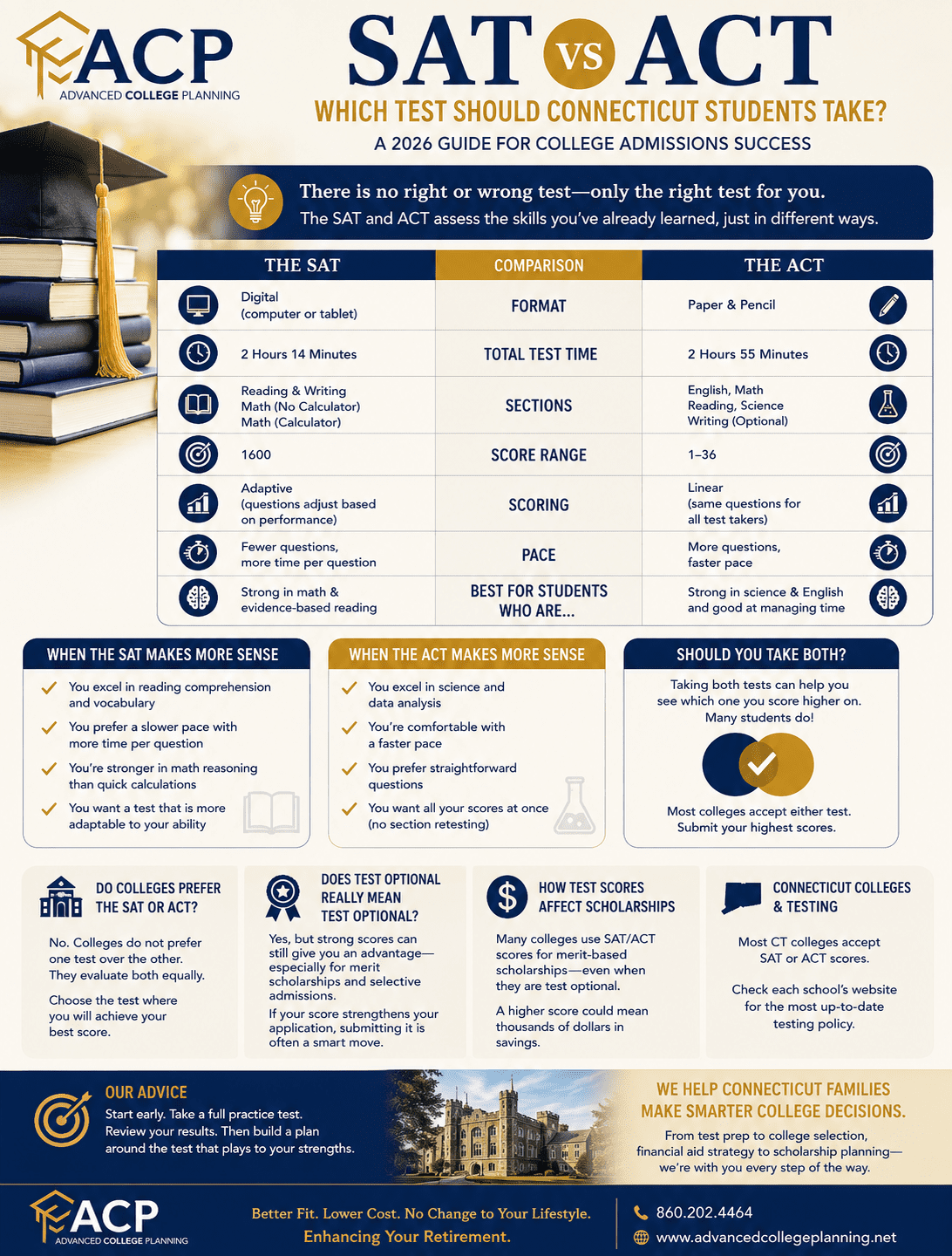
Quick Answer: SAT or ACT?
- Colleges generally accept both the SAT and ACT equally.
- Most students naturally perform better on one test.
- A stronger score can help with admissions and merit scholarships.
- Test Optional does not always mean test scores are irrelevant.
- The best starting point is taking one full SAT practice test and one full ACT practice test.
What Is the Difference Between the SAT and ACT?
The SAT and ACT both measure college readiness, but they test students in different ways.
The SAT
The SAT is now digital and includes Reading and Writing, plus Math. The test is adaptive, meaning the difficulty of later questions can adjust based on how the student performs earlier in the test.
Students who are strong readers, careful thinkers, and comfortable with multi-step math problems may prefer the SAT.
You can review official SAT information from the College Board.
The ACT
The ACT includes English, Math, Reading, and Science. The Science section does not require advanced science knowledge. It mainly tests how quickly students can interpret charts, data, graphs, and experiments.
Students who read quickly, manage time well, and prefer more straightforward questions may prefer the ACT.
You can review official ACT information at ACT.org.
Do Colleges Prefer the SAT or ACT?
No. Most colleges do not prefer one test over the other.
Admissions offices typically evaluate whichever test score creates the strongest academic profile for the student. That means the goal should not be choosing the more popular test. The goal should be choosing the test that gives your student the strongest result.
Advanced College Planning Tip: Families should not assume the SAT is better because it is more familiar in Connecticut. The ACT may be the better fit for some students, especially those who work quickly and do well with data-based questions.
Does Test Optional Mean Test Scores Do Not Matter?
Not always.
Many colleges became Test Optional during the pandemic, and many still allow students to apply without submitting SAT or ACT scores. But that does not mean scores have no value.
Strong scores may still help with:
- Merit scholarships
- Honors College consideration
- Competitive academic programs
- Course placement
- Application strength at selective colleges
This is why families should evaluate testing as part of a broader college planning strategy, not as an isolated admissions decision.
Can SAT or ACT Scores Help Students Earn Scholarships?
Yes, in many cases.
Some colleges use scholarship formulas that consider GPA, course rigor, class performance, and standardized test scores. Other colleges may use scores when deciding between students with similar academic profiles.
Even at some Test Optional schools, submitting a strong SAT or ACT score may improve a student’s chances of receiving merit-based aid.
This matters because families often focus only on getting accepted. But acceptance is only part of the equation. The real goal is helping the student attend the right college at the lowest possible cost.
When the SAT May Make More Sense
The SAT may be a better fit if your student:
- Is strong in reading comprehension
- Likes vocabulary and evidence-based reading
- Prefers fewer questions with more time per question
- Does well with multi-step math reasoning
- Feels comfortable with a digital adaptive test
When the ACT May Make More Sense
The ACT may be a better fit if your student:
- Reads quickly
- Works well under time pressure
- Prefers direct, straightforward questions
- Is comfortable interpreting charts and graphs
- Wants all questions to be presented in a linear format
Should Connecticut Students Take Both Tests?
Many students should at least compare both.
A smart strategy is to begin with one full-length SAT practice test and one full-length ACT practice test. Once the results are reviewed, families can choose the test that gives the student the best opportunity to improve.
This prevents families from wasting months preparing for the wrong exam.
Connecticut Colleges and Testing Policies
Families applying to Connecticut colleges should review each school’s current testing policy before submitting applications. Policies can change from year to year.
Common Connecticut colleges families ask us about include:
Before deciding whether to submit scores, families should consider the student’s academic profile, target schools, scholarship potential, and overall application strategy.
Do Not Let Testing Drive the Entire College List
Testing is important, but it should not be the only factor driving the college search.
At Advanced College Planning, we help families evaluate the full picture:
- Academic fit
- Social fit
- Financial fit
- Merit scholarship potential
- FAFSA and CSS Profile strategy
- College essay planning
- SAT and ACT preparation
- Financial aid appeals
- College selection and application timelines
The goal is not just getting into college. The goal is finding the right college, at the right price, without putting unnecessary pressure on the family.
Expert Insight: The strongest admissions and scholarship outcomes happen when testing, academics, college selection, financial aid strategy, and family finances are all working together.
How Advanced College Planning Helps Connecticut Families
Advanced College Planning has helped Connecticut families navigate the college process for more than 34 years. We are not just a test prep company, essay consultant, or financial aid form service.
We help students and parents build a complete college plan.
That includes helping the student find the right academic and social fit, while helping the family understand financial aid, scholarships, college costs, and long-term affordability.
Our mission is simple:
Better fit. Lower cost. No change to your lifestyle. Enhancing your retirement.
Frequently Asked Questions About SAT vs ACT
Is the SAT easier than the ACT?
No test is easier for every student. Some students perform better on the SAT, while others perform better on the ACT. The best way to know is to compare practice test results.
Do colleges care whether students submit the SAT or ACT?
Most colleges accept both exams equally. Students should submit the score that best supports their application.
Should students submit scores to Test Optional colleges?
Sometimes. If the score strengthens the application or improves scholarship potential, submitting may be smart. If the score weakens the application, applying Test Optional may be better.
Can SAT or ACT scores help with merit scholarships?
Yes. Many colleges consider test scores when awarding merit scholarships, honors opportunities, or competitive academic awards.
When should students start SAT or ACT prep?
Many students benefit from beginning during sophomore or junior year. Waiting until senior year can limit testing dates and scholarship opportunities.
Ready to Build a Smarter College Plan?
Choosing between the SAT and ACT is only one piece of the college planning process. We help Connecticut families connect testing, admissions, scholarships, financial aid, and college selection into one complete strategy.
About the author
Jeffrey Bliss
Lead College Planner · Advanced College Planning, LLC
Jeff helps Connecticut families find right-fit colleges and win the merit aid that lowers the real cost of attendance. His focus: merit aid strategy, SAT/ACT planning, FAFSA & CSS Profile guidance, and financial aid appeals.