College Planning in Hartford County: How Families Find the Right College at the Right Price
For many families in Hartford County, college planning begins with a simple question:
Where should my child apply?
But the real question is much bigger.
Which colleges are the best academic, social, and financial fit?
Which schools are likely to offer merit scholarships?
Which colleges may be generous with need-based financial aid?
Should your student submit SAT or ACT scores?
How much should your family actually pay?
And how do you help your child make a confident college decision without putting your retirement at risk?
That is where comprehensive college planning matters.
Quick Answer: What Should College Planning Include?
College planning in Hartford County should include more than a college list. A complete plan should connect admissions strategy, SAT and ACT prep, college essays, FAFSA, CSS Profile, merit scholarships, award letter review, financial aid appeals, student goals, parent finances, and long-term college funding.
At Advanced College Planning, we help families throughout Hartford County navigate the entire college process, including admissions strategy, SAT and ACT prep, college essays, financial aid forms, college list building, scholarship strategy, award appeals, and retirement-aware college funding.
The goal is not simply to get into college.
The goal is to help your student find the right college, at the right price, with a plan that supports the whole family.
What Does College Planning Actually Include?
Many families hear the phrase “college planning” and assume it means one thing. Some think it means SAT prep. Some think it means college essays. Some think it means filling out the FAFSA. Some think it means hiring someone to help with applications.
Those pieces matter, but true college planning is much more complete.
A comprehensive college planning process looks at the student as an individual and the family as a whole. It connects academic goals, admissions strategy, career interests, testing, essays, financial aid, merit scholarships, tax considerations, cash flow, retirement planning, and parent concerns into one coordinated plan.
That matters because college decisions are not made in isolation. A student’s intended major can affect which colleges make sense. A family’s income and assets can affect financial aid eligibility. A college’s scholarship policies can change the real cost dramatically. A strong essay can improve how a student is understood by an admissions office. A properly built college list can improve both admissions outcomes and financial outcomes.
When these pieces are handled separately, families can miss opportunities. When they are coordinated, families can make better decisions.
Admissions Help vs. Comprehensive College Planning
Some families only need help with one part of the process. Others need a full strategy that connects every major decision.
| Part of the Process | Admissions-Only Help | Comprehensive College Planning |
|---|---|---|
| SAT and ACT strategy | Sometimes | Yes |
| College essays | Often | Yes |
| College list development | Often | Yes |
| Major and career exploration | Sometimes | Yes |
| FAFSA guidance | Rarely | Yes |
| CSS Profile guidance | Rarely | Yes |
| Merit scholarship targeting | Sometimes | Yes |
| Financial aid award review | Rarely | Yes |
| Award appeal strategy | Rarely | Yes |
| College cost comparison | Rarely | Yes |
| Retirement-aware funding strategy | Rarely | Yes |
| Final decision support | Sometimes | Yes |
This is why college planning is not just about getting accepted. It is about helping the student and the family make a smart, confident, affordable decision.
Why Hartford County Families Need a Comprehensive College Planning Strategy
Hartford County families often face a difficult college planning challenge.
Many families earn too much to assume they will receive large federal need-based aid, but not enough to comfortably pay the full cost of college without stress. Some families own homes with equity. Some own businesses. Some are divorced or separated. Some have multiple children who will attend college close together. Some are trying to help a student pursue a selective college, a specialized academic program, or an athletic opportunity while still protecting the family’s long-term financial future.
At the same time, college pricing is confusing. The published cost of attendance includes more than tuition. It can include tuition, required fees, housing, food, books, supplies, transportation, and other estimated expenses. The National Center for Education Statistics explains why total cost of attendance includes more than tuition alone.
Focusing only on sticker price can be misleading. A private college with a high published price may offer strong merit aid or institutional grants. A public university may appear less expensive at first, but may not always be the lowest-cost option after scholarships, housing, travel, major fit, graduation timeline, and aid policies are considered.
The better question is: What will this college cost your family, and is it worth it for this student?
College Planning for West Hartford, Farmington, Avon, Glastonbury, and Simsbury Families
Families across Hartford County often face similar questions, but each community and each student brings a different set of goals, opportunities, and concerns.
A West Hartford family may be comparing UConn, selective private colleges, and national universities. An Avon or Farmington family may be trying to understand whether a student should chase highly selective admissions, merit scholarships, or specialized academic programs. A Glastonbury or Simsbury family may be balancing strong academics, competitive extracurriculars, college visits, testing timelines, and the real cost of attendance.
The strategy should never be generic. A strong college plan should be built around the student’s academic profile, goals, interests, family finances, college list, testing strategy, and likely aid outcomes.
College Planning Is More Than Admissions Help
Admissions strategy is important, but it is only one part of the process. A strong college plan should help answer questions like:
- What type of college environment fits this student best?
- Which majors or career paths should we explore?
- Should this student take the SAT, ACT, both, or neither?
- How can the student improve their academic profile?
- Which colleges are realistic, which are reaches, and which are financial fits?
- Which schools are likely to offer merit scholarships?
- Which colleges require the FAFSA, CSS Profile, or additional financial aid forms?
- How should the family compare financial aid award letters?
- Can an award be appealed?
- How much should parents borrow, if anything?
- How will college payments affect retirement?
Families do not need more confusion. They need a clear plan.
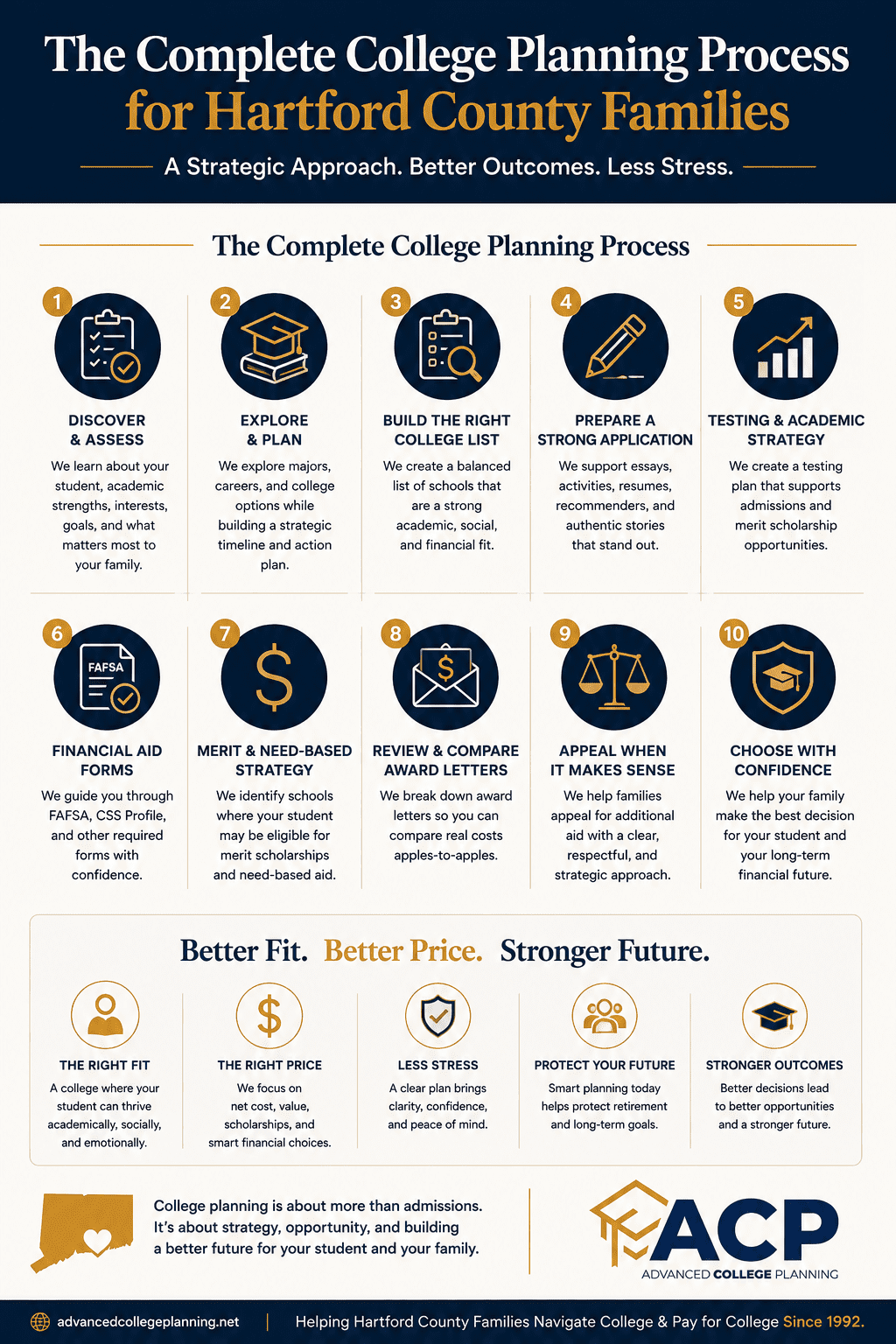
The Complete College Planning Process
The strongest college decisions come from connecting admissions, essays, testing, financial aid, scholarships, award appeals, and long-term family finances into one coordinated plan.
Real Hartford County Students, Real College Outcomes
One reason Hartford County families turn to Advanced College Planning is that we are not working from theory alone. We work with students from local high schools across the region, including West Hartford, Avon, Farmington, Burlington, Rocky Hill, Cromwell, Berlin, Glastonbury, Simsbury, and surrounding communities.
Local high schools represented by recent ACP families
- Hall High School
- Conard High School
- Avon High School
- Farmington High School
- Lewis Mills High School
- Rocky Hill High School
- Cromwell High School
- Berlin High School
- Glastonbury High School
- Simsbury High School
Those students have pursued a wide range of college paths, including highly selective universities, strong public flagships, private colleges, specialized academic programs, and Division I athletic opportunities.
Highly Selective Admissions
Recent Hartford County students we have worked with have earned opportunities at highly selective colleges, including Yale and Dartmouth.
Connecticut and Regional Options
Families have compared schools such as UConn, Fairfield University, Sacred Heart University, Saint Joseph’s, UMass, Bryant University, and Marist College.
Major Public Universities
Recent ACP students have pursued opportunities at Clemson, South Carolina, North Carolina, Maryland, NC State, Florida State, Penn State, and other major public universities.
Specialized Academic Pathways
Recent outcomes have included medicine, technology, engineering, business, health sciences, and other focused academic paths.
UConn Special Program in Medicine
One recent Hartford County student was accepted to UConn’s Special Program in Medicine, an eight-year path connecting undergraduate preparation with medical education.
Division I Athletic Opportunities
Recent ACP student-athletes have pursued Division I opportunities at schools including RIT, Bryant, UConn, Marist, Penn State, and Belmont.
The point is not that every student should chase the same list of schools. The point is that every student deserves a plan built around their own strengths, goals, family finances, admissions profile, and best-fit college opportunities.
College Planning for Student-Athletes in Hartford County
Student-athletes often need a different kind of college planning conversation.
The question is not only, “Where can I play?” It is also: Is this school the right academic fit? Would the student still want to attend if athletics changed? How does the coach’s interest fit into the admissions process? What does the financial aid or scholarship package actually include? What happens if the student is injured, changes teams, or changes majors?
Athletics can open doors, but the final decision still needs to make sense academically, socially, financially, and personally. That is why student-athlete planning should be connected to the full college process, not handled separately from admissions, financial aid, scholarships, and family finances.
The Real Goal: Better Fit, Better Price
A college can be impressive and still be the wrong fit. A college can be affordable and still be the wrong choice. A college can have a strong brand name and still be a poor value for a particular student.
That is why the goal should not be prestige alone. It should not be the lowest sticker price alone. It should not be chasing rankings alone.
The goal should be: Better fit. Better price.
Better fit means the college matches the student academically, socially, emotionally, and professionally. Better price means the family understands the real cost, the aid package, the scholarship opportunity, the borrowing impact, and the long-term financial tradeoffs.
For some students, the best value may be an in-state public university. For others, it may be a private college that offers a strong merit scholarship. For others, it may be a school that looks expensive on paper but becomes affordable after institutional aid.
FAFSA, CSS Profile, and the Financial Aid Forms Families Need to Understand
Most families have heard of the FAFSA, but many do not fully understand how it works.
The FAFSA is the Free Application for Federal Student Aid. It is used to help students qualify for federal, state, and school-based financial aid programs, including grants, scholarships, work-study, and loans.
But FAFSA is not the only financial aid form that matters.
Some colleges also require the CSS Profile, which is administered by the College Board and used by participating colleges, universities, and scholarship programs to award non-federal institutional aid.
This difference matters. A family may qualify one way under FAFSA and be evaluated differently by a CSS Profile school. Some colleges may look more closely at home equity, business value, noncustodial parent information, medical expenses, or other financial details.
That does not mean families should avoid CSS Profile schools. It means they need to understand the rules before making assumptions. For example, home equity can be treated differently depending on the school, which is why families should understand how home equity may affect financial aid eligibility before building a final college list.
A strong college planning strategy helps families identify which colleges require which forms, what information may be reviewed, and how the family’s financial picture may affect aid eligibility.
Why the College List Matters So Much
One of the biggest mistakes families make is building a college list based only on name recognition.
The student likes the campus. The parent likes the ranking. A neighbor’s child went there. A guidance counselor mentioned it. The school has a popular football team. The college keeps sending emails.
None of those are enough.
A strong college list should include schools that make sense academically, socially, emotionally, and financially. It should include likely schools, target schools, realistic reach schools, financial fit schools, merit-aid schools, and program-fit schools with strong offerings in the student’s area of interest.
This is especially important for Hartford County families who may be comparing UConn, regional public universities, private colleges in New England, selective national universities, and out-of-state options. Sometimes the best financial outcome comes from applying to the right mix of schools from the beginning.
SAT and ACT Prep Still Matter
Test-optional admissions changed the college landscape, but it did not eliminate the value of strong SAT or ACT scores.
For some students, submitting scores can strengthen an application. For others, scores may support merit scholarship eligibility. For some colleges and programs, testing can still play a meaningful role.
A smart testing plan should consider the student’s baseline score, the schools on the college list, merit scholarship opportunities, test-optional policies, academic profile, available time before deadlines, and whether the SAT or ACT is a better fit.
At Advanced College Planning, SAT and ACT prep are part of the broader strategy. The goal is not testing for the sake of testing. The goal is to determine whether stronger scores can improve admissions, scholarship, or college choice outcomes.
College Essays Are Not Just Writing Assignments
College essays are another area where families often underestimate the strategy involved.
A strong essay should not simply repeat the resume. It should reveal something meaningful about the student, their values, their growth, their perspective, or the way they think.
The best essays help admissions officers understand the person behind the grades and activities. But essays also need to fit the larger application strategy: what the student is trying to communicate, what strengths are already obvious, what needs more context, what story helps the student stand out, and how supplemental essays show genuine interest in each college.
Financial Aid Awards Are Not Always Final
Many families assume that once a financial aid award arrives, the decision is final. That is not always true.
In some cases, families may be able to appeal for additional aid. This can be especially important when circumstances have changed, when another college has made a stronger offer, or when the original award does not reflect the family’s full financial picture.
An appeal is not a complaint. A strong appeal is respectful, organized, well-documented, and strategic. At Advanced College Planning, we help families review award letters, compare net costs, understand grants versus loans, and determine whether an appeal may make sense.
Protecting Retirement While Paying for College
College is important, but parents should not sacrifice their retirement without understanding the long-term consequences. Students can borrow for college. Parents cannot borrow for retirement in the same way.
That is why college funding decisions need to be made carefully. Families should understand how much they can reasonably pay from income, savings, cash flow, scholarships, student loans, parent loans, home equity, or other resources.
A college may be a wonderful fit, but that does not automatically mean it is financially responsible. The goal is balance: helping the student move forward while helping parents stay financially stable.
Common Mistakes Hartford County Families Make During the College Process
Waiting Until Senior Year
Senior year is not too late to get help, but earlier planning creates more options. Starting in sophomore or junior year can help with course selection, testing strategy, college list development, essays, financial planning, and scholarship positioning.
Looking Only at Sticker Price
The published cost of college does not tell the full story. Some expensive schools discount heavily. Some lower-cost schools may offer less aid. Families need to compare net cost, not just sticker price.
Assuming the FAFSA Tells the Whole Story
FAFSA is important, but some colleges require additional forms, including the CSS Profile. Institutional aid rules can vary significantly by school.
Treating Admissions and Financial Aid Separately
Admissions strategy and financial strategy should work together. The right college list can improve both acceptance odds and affordability.
Overlooking Merit Aid
Some families assume scholarships are only for perfect students. That is not true. Many colleges use merit aid to attract students who fit their enrollment goals.
Borrowing Too Much
Loans can be part of a college funding plan, but they should be used carefully. Families should understand monthly payments, interest, repayment timelines, and the impact on future goals.
Choosing Based on Emotion Alone
College is emotional. That is normal. But the final decision should include fit, cost, academic opportunity, career direction, graduation likelihood, and family finances.
How Advanced College Planning Helps Hartford County Families
Advanced College Planning works with families across Hartford County, including West Hartford, Glastonbury, Rocky Hill, Wethersfield, Newington, Farmington, Avon, Simsbury, Southington, South Windsor, Manchester, Cromwell, Berlin, Burlington, and surrounding communities.
Our role is to help families make the college process more organized, strategic, and less overwhelming. We help students understand their options. We help parents understand the numbers. We help families compare schools clearly. We help identify opportunities for merit aid. We help prepare stronger applications. We help with SAT and ACT prep. We help with essays. We help with financial aid forms. We help review award letters. We help families appeal when appropriate. We help parents think about college costs without losing sight of retirement.
Most importantly, we help families move through this process with more confidence.
When Should Families Start College Planning?
The best time to start college planning is usually before the pressure becomes overwhelming. For many families, that means sophomore or junior year of high school.
Sophomore year can be a good time to begin career and major exploration, course planning, early testing decisions, and basic financial conversations. Junior year is often when college list building, SAT or ACT prep, campus visits, admissions strategy, and financial planning become more focused.
Senior year is when applications, essays, FAFSA, CSS Profile, award letters, appeals, and final decisions come together. Even if your student is already a senior, it is not too late to improve the process. The key is to stop guessing and start planning.
FAQ: College Planning in Hartford County
What does a college planning consultant do?
A college planning consultant helps families navigate the college process more strategically. That may include college list development, admissions strategy, SAT or ACT prep, essay support, financial aid planning, scholarship strategy, award letter review, and help comparing final college options.
Is college planning only for high school seniors?
No. Seniors often need immediate help with applications, essays, financial aid forms, and final decisions, but many families benefit from starting earlier. Sophomore and junior year planning can create more options.
Does college planning include SAT and ACT prep?
At Advanced College Planning, yes. SAT and ACT prep are part of the comprehensive process when testing makes sense for the student’s goals, college list, and scholarship opportunities.
Does college planning include college essays?
Yes. College essays are an important part of the admissions process. We help students develop essays that are thoughtful, authentic, and aligned with the overall application strategy.
Can college planning help reduce the cost of college?
Yes, in many cases. A strong college planning strategy can help families identify schools that may offer better merit scholarships, stronger need-based aid, or a better overall value. It can also help families avoid costly mistakes.
Do you help with FAFSA and CSS Profile?
Yes. We help families understand FAFSA, CSS Profile, and other financial aid requirements. We also help families understand how different colleges may evaluate financial information.
Do you help families appeal financial aid awards?
Yes. When appropriate, we help families review financial aid awards and prepare respectful, well-supported appeals for additional aid.
Do you work with student-athletes?
Yes. We help student-athletes and their families think strategically about academic fit, athletic opportunities, admissions requirements, communication, cost, and long-term college value.
How is Advanced College Planning different from an essay coach or test prep company?
Advanced College Planning offers a comprehensive approach. We help with SAT and ACT prep and essays, but we also help with admissions strategy, college list building, financial aid, merit aid, award appeals, and retirement-aware college funding.
Do you work with families outside Hartford County?
Yes. While many of our families are located in Hartford County and throughout Connecticut, we also work with families in other areas who want a more complete and strategic college planning process.
Start With a Smarter College Plan
The college process does not have to feel like a guessing game.
With the right strategy, families can make better decisions, avoid costly mistakes, and help students find colleges where they can thrive.
At Advanced College Planning, we help Hartford County families look beyond acceptance letters and sticker prices. We help them understand fit, value, aid, scholarships, essays, testing, applications, and the long-term impact of college costs.
Because the goal is not just getting into college. The goal is finding the right college, at the right price, with a plan that supports the student and the family.
About the author
Jeffrey Bliss
Lead College Planner · Advanced College Planning, LLC
Jeff helps Connecticut families find right-fit colleges and win the merit aid that lowers the real cost of attendance. His focus: merit aid strategy, SAT/ACT planning, FAFSA & CSS Profile guidance, and financial aid appeals.